
What Is Your Ideal Lifestyle…
Discover What Is and What is To Be on Your Journey of Life…
Click the two cards below to see what Present and Future you have drawn. Then click again to get the description and recommendations for your specific situation. Watch for follow-up emails with even more information to guide you…
Be sure to write down the names of your two cards, so you can access additional information later.
Passive Income Lifestyle
This card will tell you how things are now…

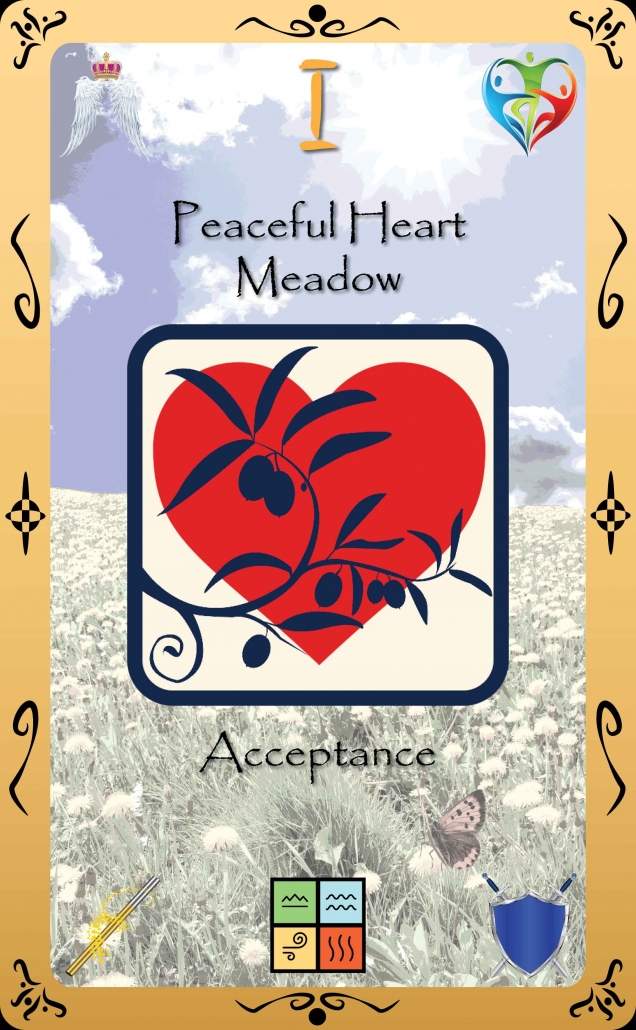
Peaceful Heart Meadow
Acceptance
Overview
Our ego-minds spend a great deal of time trying to keep us safe—sometimes in ways that, on close inspection, may seem quite dysfunctional. We often find ourselves trying to make sense of our circumstances by putting our own spin on things—that is, we analyze, explain, justify, or interpret our situations without really making any effort to accept them as they are. In other words, we unconsciously tend to reject what is in favor of our own story or thinking about what is.
In Peaceful Heart Meadow, we begin to learn about the first Key Skill: Acceptance. As we become more aware of what is, our first priority is to accept it as it is. That is, we suspend our judgments, conclusions or stories about it, so that we can grok it more clearly for what it really is—rather than for what we think it is.
Acceptance is not about agreeing with anything; it’s not about condoning anything; it’s not about believing in anything. All of those actions—agreeing, condoning, believing—require you to analyze, explain, justify or interpret what is, which puts you back into your ego-mind, and disconnects you from your innate ability to accept. Acceptance is simply about being fully aware of what is and acknowledging it as such—in other words, Acceptance is Awareness without Story. If you get out of your head and into your heart, you engage your natural power to accept what is. Once you have accepted it for what it really is, then and only then can you actually do something about it.
Situation
Something unpleasant, painful or tragic is happening in your life right now, and it has triggered many different reactions within you. In essence, your reactions are just variations of your overall rejection of the situation, and your rejection of what is merely increases your pain and discomfort without in any way changing the situation. Your desire to reject what’s happening may be quite understandable, because the situation itself is causing you pain and distress. Perhaps you are having thoughts like these:
- This situation is completely unacceptable; I have to find a way to make it go away.
- This can’t be happening to me…again!
- If I accept this, then it means that I’m agreeing with it. I simply can’t allow that to happen.
- I don’t like it; I don’t want it; I don’t choose it. I refuse to allow it into my life.
Recommendation
If you’ve ever had a massage, then you probably remember a time when your massage therapist found a place on your body that felt painful to the touch. And when that happened, you probably had an instant reaction to tense your body and protect yourself from the pain. Interestingly, however, if you allowed yourself to consciously relax the muscles and accept the temporary pain of the therapist’s touch, then pretty quickly the pain subsided and the movement of the therapist’s hands actually relieved some deep-rooted tension, and therefore provided some much needed healing.
Think of Acceptance in the same way. Your current situation may be unpleasant or painful, but you can alleviate that pain significantly simply by acknowledging it, relaxing into it and allowing your breath to carry it away.
Find a quiet place where you can follow this simple process to help you return to a place of acceptance:
- Take some deep breaths to ground yourself and bring yourself into the present moment. Bring attention to your emotions, thoughts, and physical sensations. Avoid any judgments, interpretations or conclusions as you do this. Just keep breathing gently and maintain your perspective as an observer.
- When you feel sufficiently present and relaxed, allow your inner observer to take a closer look at the issue that has been triggering resistance. What is it about this issue that agitates you to the point that you want to push it away? Does the issue bring up any self-judgments or stories that challenge your ability to stay present? Again, avoid any judgments as you do this; simply observe the situation and what it brings up for you.
- Bring the energy of compassion and forgiveness to yourself for the way you are reacting to the situation. Imagine that you are wrapping yourself in a big, unconditionally loving hug. Remind yourself that everything about you is perfectly okay—including any reaction or feeling you may have had up to now.
- Take a few more deep breaths, and simply release your energy of resistance. Imagine that you putting all the resistance energy into an expanding balloon; imagine opening a window in your heart and allowing that balloon simply to float off into the distance. Watch it disappear over the horizon, never to come back into your body.
- Take a few more deep breaths, and see yourself accepting your situation exactly as it is. It is neither good nor bad, right nor wrong; it simply is what it is. In your mind’s eye, see yourself examining the situation from all angles, maximizing your awareness of everything it contains.
- Take some time now to honor yourself for bringing yourself back to a place of acceptance.
At this point, you have really completed the exercise. Give yourself some time to let the process anchor within you. After sufficient time has passed, and you believe you have fully accepted the situation for what it is, you will find yourself better equipped to decide exactly what steps you want to take to move forward.

For more information about this topic, please see the full program at Life Mastery Way (and remember the name of your card).
Easy Do-It-Yourself
This card will tell you how things are now…

Karma Crossroads
Choice
Overview
One thing that we all have available to us in every moment is Choice. It may not always seem that way, though.
Sometimes, some of the alternatives available to us may be completely unacceptable for any number of reasons, so it may seem that there is only one viable option, even if that last remaining option is distasteful—in which case, it is usually the least of all evils. When this happens, we may think that we really have no choice at all—or that we are forced into something we didn’t really want.
In other circumstances, we may be making our choices unconsciously. In this case, we may be operating on “auto-pilot”, making decisions without even being aware. The problem here is that, when we aren’t aware of our choices, then we are certainly not aware of their impact, and we may not realize how our actions are affecting the world around us.
In Karma Crossroads, we look at the concept of Choice in a new way, and we learn how to make our choices both consciously and responsibly.
Situation
Lately, you have been making a lot of your choices unconsciously, and you are now becoming aware of some of the unintended consequences of those choices. Some of the people around you are beginning to express displeasure or even upset because of your words or actions. Some of them may even be describing pain in their relationship with you. And now, you are beginning to feel internal guilt or shame because of the current situation, and the voice inside your head may be berating you for some of these choices, with words like:
- How could you be so bone-headed as to make a decision like that?
- What on earth were you thinking? You should have known this would happen.
In addition, you are feeling significant emotional pain of your own right now, worrying that you may not be able to make things right.
Recommendation
The first thing you must realize is that you cannot respond to anything anyone is saying to you from a place of knee-jerk reaction. The easiest way to deal with people who are upset with you right now is simply to say to them: I’m sorry to hear that you are upset, and I thank you for your feedback. I am not in a space to respond right now, but I will consider what you’ve said and get back to you later today. Then, find yourself a safe and quiet space where you can do some gentle and loving introspection.
As with all Life Mastery processes, begin by getting yourself into a relaxing position and take some slow deep breaths to help raise your awareness. Notice what is going on around you and within you and allow yourself to observe everything without judgment or interpretation.
As your level of relaxation and awareness increase, do a time scan over the recent past to observe the choices you have made. Pay close attention to the energy you had when you made those choices. Were you under some kind of pressure that led you to choose without putting your full attention and intention into those choices? Or were you simply operating on “auto-pilot”? Whatever the case, simply observe without judgment or interpretation.
As you become aware of all of the choices you made without due consideration of possible consequences, forgive yourself for slipping into unconsciousness, and make a personal commitment to bring consciousness and intention into all of your choices going forward.
After you have completed this introspection, you can take a few more deep breaths, and honor yourself for doing the work necessary to take responsible stock of all of the choices you have made.
When you are ready, return to the people who have confronted you and take full ownership of the choices you made and why you made them. If necessary, apologize for any unintended consequences you may have created, and commit to those people your intention to choose more consciously in the future.
For more information about this topic, please see the full program at Life Mastery Way (and remember the name of your card).
Easy Do-It-For-You…
This card will tell you how things will be in the future…


Peaceful Heart Meadow
Acceptance
Overview
Our ego-minds spend a great deal of time trying to keep us safe—sometimes in ways that, on close inspection, may seem quite dysfunctional. We often find ourselves trying to make sense of our circumstances by putting our own spin on things—that is, we analyze, explain, justify, or interpret our situations without really making any effort to accept them as they are. In other words, we unconsciously tend to reject what is in favor of our own story or thinking about what is.
In Peaceful Heart Meadow, we begin to learn about the first Key Skill: Acceptance. As we become more aware of what is, our first priority is to accept it as it is. That is, we suspend our judgments, conclusions or stories about it, so that we can grok it more clearly for what it really is—rather than for what we think it is.
Acceptance is not about agreeing with anything; it’s not about condoning anything; it’s not about believing in anything. All of those actions—agreeing, condoning, believing—require you to analyze, explain, justify or interpret what is, which puts you back into your ego-mind, and disconnects you from your innate ability to accept. Acceptance is simply about being fully aware of what is and acknowledging it as such—in other words, Acceptance is Awareness without Story. If you get out of your head and into your heart, you engage your natural power to accept what is. Once you have accepted it for what it really is, then and only then can you actually do something about it.
Situation
You are in the center of a confluence of events and circumstances that will lead to a situation you will find intolerable or unacceptable. Your unconscious reaction to this situation will put you in a place of powerful resistance to what is happening, and your resistance will in turn complicate the situation and exacerbate your own discomfort and upset. If you are not careful, this may lead to additional hardship or heartbreak for you.
Recommendation
You may not be able to change or stop whatever circumstances are coming your way, but you can certainly prepare yourself so that you are able to deal with them from a place of calm equanimity. The way to do this is to practice Acceptance for situations that are relatively easy to accept; then, as you gain confidence in your ability, you will find that bringing the same level of Acceptance to more challenging situations will become easier.
For a situation which has not yet come into being, it may be difficult for you to cultivate an accepting attitude in advance. However, you can use the Future Presence process to help you:
- Use your imagination to create a challenging but realistic scenario that has a reasonably high likelihood of coming to pass in your life. Put this scenario somewhere into your future, and imagine that it is something that is certain to happen.
- In your mind travel forward to a time a few days following the event in question, and begin to imagine that you dealt with the situation with complete success, because you were able to fully accept it as it was.
- In your mind, conduct a short interview with your future self. Ask him/her the following questions:
- How did you stay fully present and aware during this difficult time?
- When you found yourself resisting the situation, how did you bring yourself back to a place of Acceptance?
- What difference did your Acceptance make in your handling of the situation?
- What were you thinking as the situation progressed?
- What were you feeling?
- How do you feel now that the situation has passed?
- Take note of all the answers that you get, and bring your new understanding back to the present moment.
Recognize and understand that you have the capability to accept any situation for what it is, no matter how challenging it might appear to be. You can use this new understanding to prepare you more fully for what is yet to come.
For more information about this topic, please see the full program at Life Mastery Way (and remember the name of your card).
Assetizing…
This card will tell you how things are now…

Base Camp
Awareness
Overview
When you are about to set out on a journey, before you can ever hope to know how to get where you want to go, you must first be very clear about where you are right now. In other words, you must make sure you know as much as possible about your current situation, conditions, environment and circumstances.
This is Awareness, the foundational skill of Life Mastery Way. Because it is so important, we learn about it first at our centering and grounding station, what we call Base Camp. Your objective is to bring Awareness into every aspect of your life and, as much as possible, keep it present in every moment. This means being aware of what is going on in your surroundings, and also within you—that is, your emotions, thoughts and sensations.
Situation
Lately, you have been operating much like a sleep-walker. That is, you have slipped into an unconscious behavior pattern; it may seem as if you are flying on auto-pilot. Obviously, you have not done this deliberately, but you are probably experiencing moments where you think things like these:
- How did I get here? I don’t remember the last 30 minutes.
- I am way off-kilter here; I seem to be bouncing around from one thing to another with no sense of direction.
- I am totally confused and disoriented; I need to get back on track.
Recommendation
It is important to stop whatever you are doing, at least until you can bring more Awareness into your current situation. Find a quiet place where you can sit and relax. Take a few deep cleansing breaths and bring awareness to all aspects of your situation.
External Inventory
Take stock of everything around you, and bring your focus to as many details as possible. Notice the shapes and colors of all objects around you. Notice the temperature of the room or the space. If you are outdoors, take not of the details of the weather conditions. Are there people or animals around, or are you alone? What kind of objects are around you? Just notice as much as you can without making up any story or drawing any judgments or conclusions about any of it.
Internal Inventory
Now bring your attention to your body. Notice any physical sensations that you might be feeling: cold/hot, relaxed/tense, hungry, clammy, shivery, etc. Again, avoid any judgment or interpretation; just take stock.
Next, notice the emotions that you are feeling. Try to limit your words to one of the four primary emotions: sadness, fear, anger, or joy. Is it a strong or weak emotion at this time? How long have you been feeling this emotion? Again, no judgment; just observation.
Finally, bring your attention to your thoughts. What are you thinking? Are your thoughts related to a common theme? Do you notice a judgmental or interpretational quality to your thoughts? How long have these thoughts been present in your mind?
Introspection
Now that you have elevated your awareness about your current internal and external state, take a few moments to see if you can peek under the covers and find out more about how you came to be in this state. Here are a few questions you can ask yourself—remember not to judge yourself for your current state:
- How did I attract my current situation into my life?
- What is the purpose for my current behavior?
- In what ways are my thoughts, words, actions and emotions aligned with my purpose?
- In what ways are they out of alignment?
- Do I wish to change this situation? If so, what new choice will I make?
Final Steps
Once you are complete with this process, take some time to honor yourself for having had sufficient
Awareness to know that you were operating unconsciously, and for having the courage to look inside to find out what was really going on. Notice how you are feeling now, and take this new feeling into the next phase of your life.
For more information about this topic, please see the full program at Life Mastery Way (and remember the name of your card).
Automated Modeling
This card will tell you how things are now…
Peaceful Heart Meadow
Acceptance
Overview
Our ego-minds spend a great deal of time trying to keep us safe—sometimes in ways that, on close inspection, may seem quite dysfunctional. We often find ourselves trying to make sense of our circumstances by putting our own spin on things—that is, we analyze, explain, justify, or interpret our situations without really making any effort to accept them as they are. In other words, we unconsciously tend to reject what is in favor of our own story or thinking about what is.
In Peaceful Heart Meadow, we begin to learn about the first Key Skill: Acceptance. As we become more aware of what is, our first priority is to accept it as it is. That is, we suspend our judgments, conclusions or stories about it, so that we can grok it more clearly for what it really is—rather than for what we think it is.
Acceptance is not about agreeing with anything; it’s not about condoning anything; it’s not about believing in anything. All of those actions—agreeing, condoning, believing—require you to analyze, explain, justify or interpret what is, which puts you back into your ego-mind, and disconnects you from your innate ability to accept. Acceptance is simply about being fully aware of what is and acknowledging it as such—in other words, Acceptance is Awareness without Story. If you get out of your head and into your heart, you engage your natural power to accept what is. Once you have accepted it for what it really is, then and only then can you actually do something about it.
Situation
Something unpleasant, painful or tragic is happening in your life right now, and it has triggered many different reactions within you. In essence, your reactions are just variations of your overall rejection of the situation, and your rejection of what is merely increases your pain and discomfort without in any way changing the situation. Your desire to reject what’s happening may be quite understandable, because the situation itself is causing you pain and distress. Perhaps you are having thoughts like these:
- This situation is completely unacceptable; I have to find a way to make it go away.
- This can’t be happening to me…again!
- If I accept this, then it means that I’m agreeing with it. I simply can’t allow that to happen.
- I don’t like it; I don’t want it; I don’t choose it. I refuse to allow it into my life.
Recommendation
If you’ve ever had a massage, then you probably remember a time when your massage therapist found a place on your body that felt painful to the touch. And when that happened, you probably had an instant reaction to tense your body and protect yourself from the pain. Interestingly, however, if you allowed yourself to consciously relax the muscles and accept the temporary pain of the therapist’s touch, then pretty quickly the pain subsided and the movement of the therapist’s hands actually relieved some deep-rooted tension, and therefore provided some much needed healing.
Think of Acceptance in the same way. Your current situation may be unpleasant or painful, but you can alleviate that pain significantly simply by acknowledging it, relaxing into it and allowing your breath to carry it away.
Find a quiet place where you can follow this simple process to help you return to a place of acceptance:
- Take some deep breaths to ground yourself and bring yourself into the present moment. Bring attention to your emotions, thoughts, and physical sensations. Avoid any judgments, interpretations or conclusions as you do this. Just keep breathing gently and maintain your perspective as an observer.
- When you feel sufficiently present and relaxed, allow your inner observer to take a closer look at the issue that has been triggering resistance. What is it about this issue that agitates you to the point that you want to push it away? Does the issue bring up any self-judgments or stories that challenge your ability to stay present? Again, avoid any judgments as you do this; simply observe the situation and what it brings up for you.
- Bring the energy of compassion and forgiveness to yourself for the way you are reacting to the situation. Imagine that you are wrapping yourself in a big, unconditionally loving hug. Remind yourself that everything about you is perfectly okay—including any reaction or feeling you may have had up to now.
- Take a few more deep breaths, and simply release your energy of resistance. Imagine that you putting all the resistance energy into an expanding balloon; imagine opening a window in your heart and allowing that balloon simply to float off into the distance. Watch it disappear over the horizon, never to come back into your body.
- Take a few more deep breaths, and see yourself accepting your situation exactly as it is. It is neither good nor bad, right nor wrong; it simply is what it is. In your mind’s eye, see yourself examining the situation from all angles, maximizing your awareness of everything it contains.
- Take some time now to honor yourself for bringing yourself back to a place of acceptance.
At this point, you have really completed the exercise. Give yourself some time to let the process anchor within you. After sufficient time has passed, and you believe you have fully accepted the situation for what it is, you will find yourself better equipped to decide exactly what steps you want to take to move forward.
For more information about this topic, please see the full program at Life Mastery Way (and remember the name of your card).
Cash Pumping In…
This card will tell you how things will be in the future…
Peaceful Heart Meadow
Acceptance
Overview
Our ego-minds spend a great deal of time trying to keep us safe—sometimes in ways that, on close inspection, may seem quite dysfunctional. We often find ourselves trying to make sense of our circumstances by putting our own spin on things—that is, we analyze, explain, justify, or interpret our situations without really making any effort to accept them as they are. In other words, we unconsciously tend to reject what is in favor of our own story or thinking about what is.
In Peaceful Heart Meadow, we begin to learn about the first Key Skill: Acceptance. As we become more aware of what is, our first priority is to accept it as it is. That is, we suspend our judgments, conclusions or stories about it, so that we can grok it more clearly for what it really is—rather than for what we think it is.
Acceptance is not about agreeing with anything; it’s not about condoning anything; it’s not about believing in anything. All of those actions—agreeing, condoning, believing—require you to analyze, explain, justify or interpret what is, which puts you back into your ego-mind, and disconnects you from your innate ability to accept. Acceptance is simply about being fully aware of what is and acknowledging it as such—in other words, Acceptance is Awareness without Story. If you get out of your head and into your heart, you engage your natural power to accept what is. Once you have accepted it for what it really is, then and only then can you actually do something about it.
Situation
You are in the center of a confluence of events and circumstances that will lead to a situation you will find intolerable or unacceptable. Your unconscious reaction to this situation will put you in a place of powerful resistance to what is happening, and your resistance will in turn complicate the situation and exacerbate your own discomfort and upset. If you are not careful, this may lead to additional hardship or heartbreak for you.
Recommendation
You may not be able to change or stop whatever circumstances are coming your way, but you can certainly prepare yourself so that you are able to deal with them from a place of calm equanimity. The way to do this is to practice Acceptance for situations that are relatively easy to accept; then, as you gain confidence in your ability, you will find that bringing the same level of Acceptance to more challenging situations will become easier.
For a situation which has not yet come into being, it may be difficult for you to cultivate an accepting attitude in advance. However, you can use the Future Presence process to help you:
- Use your imagination to create a challenging but realistic scenario that has a reasonably high likelihood of coming to pass in your life. Put this scenario somewhere into your future, and imagine that it is something that is certain to happen.
- In your mind travel forward to a time a few days following the event in question, and begin to imagine that you dealt with the situation with complete success, because you were able to fully accept it as it was.
- In your mind, conduct a short interview with your future self. Ask him/her the following questions:
- How did you stay fully present and aware during this difficult time?
- When you found yourself resisting the situation, how did you bring yourself back to a place of Acceptance?
- What difference did your Acceptance make in your handling of the situation?
- What were you thinking as the situation progressed?
- What were you feeling?
- How do you feel now that the situation has passed?
- Take note of all the answers that you get, and bring your new understanding back to the present moment.
Recognize and understand that you have the capability to accept any situation for what it is, no matter how challenging it might appear to be. You can use this new understanding to prepare you more fully for what is yet to come.
For more information about this topic, please see the full program at Life Mastery Way (and remember the name of your card).
Awakening
This card will tell you how things will be in the future…

Karma Crossroads
Choice
Overview
One thing that we all have available to us in every moment is Choice. It may not always seem that way, though.
Sometimes, some of the alternatives available to us may be completely unacceptable for any number of reasons, so it may seem that there is only one viable option, even if that last remaining option is distasteful—in which case, it is usually the least of all evils. When this happens, we may think that we really have no choice at all—or that we are forced into something we didn’t really want.
In other circumstances, we may be making our choices unconsciously. In this case, we may be operating on “auto-pilot”, making decisions without even being aware. The problem here is that, when we aren’t aware of our choices, then we are certainly not aware of their impact, and we may not realize how our actions are affecting the world around us.
In Karma Crossroads, we look at the concept of Choice in a new way, and we learn how to make our choices both consciously and responsibly.
Situation
New circumstances are approaching which will require you to make some potentially life-changing decisions. Your past tendency to put decisions of this type off until they “resolve themselves” may have worked to some degree for you in the past, but that approach is not going to work for you this time. If you apply that strategy in this case, the unintended consequences could create a lot of chaos—not to mention unpleasantness, pain and/or suffering—in your life.
Recommendation
Even a decision to do nothing is a choice—and it may be exactly the right choice for you under certain circumstances. But be clear: doing nothing is simply one of your available options. As long as you have examined all the options and evaluated their possible outcomes, then you are making that choice consciously—which is really the most important thing for you.
In order to prepare for whatever might be coming your way, you would be well advised to practice making all your choices as consciously as possible. The more important the situation, the more important the choice process. For every situation that shows up in your life, practice the following:
- Examine and enumerate all the relevant options that are available. Write a list and make sure you haven’t missed anything.
- For each option you have noted, write down all the relevant pros and cons you can think of. Include as much detail as you can for each one.
- Run through the option list again, and this time, for each option, rate your level of enthusiasm on a scale from 1 to 10, where 1 is “not so crazy about it”, and 10 is “can’t wait to get started.”
- For each of the most highly rated options (i.e. the ones you rated at 6 or higher), make a list of all the possible consequences that might come to pass if you make that choice. Notice whether you would be willing to take responsibility for that consequence or not.
When you have completed this process, you will have a very good idea which option is likely to produce the most desirable outcome—and whose unintended consequences you’d be most willing to accept. In this way, you are much better equipped to make a conscious, well-informed choice for which you’d be willing to take full responsibility.
This may seem like a lot to do for every choice that comes your way, so use it only for choices that feel really important to you. Also, the more you practice this process, the more efficient you will become, and soon the process will become for you more like a powerful meditation than a chore.
For more information about this topic, please see the full program at Life Mastery Way (and remember the name of your card).
Igniting…
This card will tell you how things will be in the future…
Karma Crossroads
Choice
Overview
One thing that we all have available to us in every moment is Choice. It may not always seem that way, though.
Sometimes, some of the alternatives available to us may be completely unacceptable for any number of reasons, so it may seem that there is only one viable option, even if that last remaining option is distasteful—in which case, it is usually the least of all evils. When this happens, we may think that we really have no choice at all—or that we are forced into something we didn’t really want.
In other circumstances, we may be making our choices unconsciously. In this case, we may be operating on “auto-pilot”, making decisions without even being aware. The problem here is that, when we aren’t aware of our choices, then we are certainly not aware of their impact, and we may not realize how our actions are affecting the world around us.
In Karma Crossroads, we look at the concept of Choice in a new way, and we learn how to make our choices both consciously and responsibly.
Situation
New circumstances are approaching which will require you to make some potentially life-changing decisions. Your past tendency to put decisions of this type off until they “resolve themselves” may have worked to some degree for you in the past, but that approach is not going to work for you this time. If you apply that strategy in this case, the unintended consequences could create a lot of chaos—not to mention unpleasantness, pain and/or suffering—in your life.
Recommendation
Even a decision to do nothing is a choice—and it may be exactly the right choice for you under certain circumstances. But be clear: doing nothing is simply one of your available options. As long as you have examined all the options and evaluated their possible outcomes, then you are making that choice consciously—which is really the most important thing for you.
In order to prepare for whatever might be coming your way, you would be well advised to practice making all your choices as consciously as possible. The more important the situation, the more important the choice process. For every situation that shows up in your life, practice the following:
- Examine and enumerate all the relevant options that are available. Write a list and make sure you haven’t missed anything.
- For each option you have noted, write down all the relevant pros and cons you can think of. Include as much detail as you can for each one.
- Run through the option list again, and this time, for each option, rate your level of enthusiasm on a scale from 1 to 10, where 1 is “not so crazy about it”, and 10 is “can’t wait to get started.”
- For each of the most highly rated options (i.e. the ones you rated at 6 or higher), make a list of all the possible consequences that might come to pass if you make that choice. Notice whether you would be willing to take responsibility for that consequence or not.
When you have completed this process, you will have a very good idea which option is likely to produce the most desirable outcome—and whose unintended consequences you’d be most willing to accept. In this way, you are much better equipped to make a conscious, well-informed choice for which you’d be willing to take full responsibility.
This may seem like a lot to do for every choice that comes your way, so use it only for choices that feel really important to you. Also, the more you practice this process, the more efficient you will become, and soon the process will become for you more like a powerful meditation than a chore.
For more information about this topic, please see the full program at Life Mastery Way (and remember the name of your card).
Focusing…
This card will tell you how things will be in the future…

Garden of Mercy
Compassion
Overview
It is pretty obvious that there is a lot of suffering in the world around us. And only the coldest of people would fail to feel empathy for this suffering, or to desire to find a way—no matter how small—to relieve it, or better yet, to eradicate it altogether. This internal drive to soothe or eliminate obvious suffering is what most of us recognize as Compassion, the key skill taught in Garden of Mercy. Compassion is a powerful force that, according to the Dalai Lama, is actually a primary pathway to happiness.
Ironically, while most of us have no difficulty experiencing or expressing compassion for others, all too often we have difficulty cultivating any level of compassion for ourselves and our own suffering. This is the main focus of the teaching of Garden of Mercy.
Situation
You will soon encounter circumstances involving a loved one that will challenge your natural ability to maintain your compassionate center. The loved one in question will be embroiled in circumstances of his/her own creation, resulting from some ill-considered or unconscious choices. If you allow yourself to go into reaction mode, you will find yourself berating your loved one, and making matters worse as a result of your own upset. You may also find yourself resorting to blaming or shaming statements, and telling your loved one things like “I told you so” or “You should have known better”.
Recommendation
Sometimes our loved ones do things that get them into trouble. This can be particularly difficult if the loved ones in question are children, in which case your role as a caring parent comes into play and you feel compelled to step in and help out—especially if your child is experiencing a lot of pain or suffering as a result of his/her choice. If the loved one happens to be an adult child, then things get complicated, because now you have to balance your desire to relieve suffering with the child’s need to experience the full impact of his/her choice. Of course, if the loved one in question is not one of your children, then your response will vary accordingly.
When a loved one gets into a challenging situation of his/her own creation, and it has a direct (negative) impact on you personally, you may find it difficult to remain grounded and compassionate. One of the first things you can do in this case to help remain grounded is to remember that, at one time or another in your life, you may have made a similar choice—a choice that caused problems for a lot of people you cared about. In other words, take a moment to walk a mile in the other person’s shoes.
Remember your own situation, and the pain and suffering you caused as a result of your choice. Remember how that felt. You probably experienced some guilt or shame about it, and you probably deeply regretted what you had done, but in the face of the impact you created, people around you may not have wanted to hear about that; perhaps their reaction was less than compassionate, and it may have seemed as if they wanted you to suffer even more.
Now consider your loved one. As a result of his/her choice, s/he may be going through a very similar experience as you did, so you can empathize with this person, and you can approach him/her from a place of loving compassion. You can commiserate; you can share a little about your own experience; you can listen to understand more about the choice that was made. And when that is all done, you can help the other person find ways to make reparations.
Remember, we are all here on this physical plane to express and experience the truth of who we really are. In doing that, we sometimes make choices that cause pain for others. Whenever that happens, we must remember to treat ourselves with compassion and to forgive ourselves whenever necessary. And we must be willing to take responsibility for our choices, and make amends if appropriate.
For more information about this topic, please see the full program at Life Mastery Way (and remember the name of your card).