
The Investor Type
Strategic Lifestyle…
Discover the process of achieving ultimate time and money freedom…
Click the cards below to see what each Phase of the Investor Lifestyle entails. You’ll see where you are on this journey and how to get from here to there. Watch for follow-up emails with even more information to guide you…
Phase 1: Easy Do-It-For-You…
Turning Money Into More Time for You


Alignment Ridge
Integrity
Overview
As we learn in Alignment Ridge, Integrity is a state of being in which our thoughts, words, actions and emotions are all in alignment. Being “in integrity” is a wonderful experience, and most of us know instinctively when we are there. But, as we also learn, Integrity is even more powerful when we synchronize our alignment with our sacred Purpose for being. When we create this kind of alignment, we feel inspired and motivated, perhaps even unstoppable!
No-one is “in integrity” 100% of the time; we all slip-up occasionally. Thankfully, one of the other tools we learn about in Alignment Ridge is Accountability, which enables us to perform some powerful introspection to find out how we got off track, and to create a new commitment to find our way back to our chosen path.
Situation
You will be faced with conditions and circumstances that will put at least two of your commitments in conflict with one another. You will find that you have to make choices that will pull you out of integrity with at least one of these commitments. Because you are a person who highly values integrity, this will cause you a great deal of inner turmoil; you will have difficulty making the necessary choices.
Recommendation
Whenever you have two or more commitments that come into conflict with each other, you are faced with a dilemma: Which commitment do I follow through on, and how do I minimize the damage when I break one of the others?
If you simply choose one commitment and forget about the other(s), then you risk damaging your relationship with the people involved in the broken commitments. This can get worse over time if you allow this sort of thing to happen repeatedly, because then people begin to see you as someone who doesn’t keep his/her word, who can’t be counted on, who “flakes out” and doesn’t follow through. This in turn leads to broken trust, which makes it very hard for people to stay in relationship with you. Most people will accept an apology once or twice, but after that, if there is no change in behavior, your fate is sealed with them.
So, what is the solution? Simple: Negotiation. This is a form of self-accountability because you are acknowledging that you somehow allowed two or more commitments to come into conflict with one another. You are taking responsibility for the choices you made to allow this to happen, and you are asking one or more of the people you committed to for permission to change the terms of the commitment(s).
You could approach the other party (or parties) and say something like the following:
I want to apologize to you because I’ve created a situation in which I have a conflict with the agreement I made with you. I will not be able to complete that commitment in the manner we agreed upon, and I would like to discuss with you how we might be able to re-structure the agreement in a mutually acceptable way.
The other person may not be in a position to modify the existing agreement, so you may have to try this approach with each of the other people involved. Whatever happens, make sure you approach each party with a genuine desire to find a mutually acceptable solution. Even if things don’t quite work out the way you want them to, at least you have made your best effort, preserved your integrity, and reduced the risk of broken trust with those people.

For more information about this topic, please see the full program at Life Mastery Way (and remember the name of your card).
Phase 2: Easy Do-It-Yourself
Spending Little Time While Making Lots More Money…


Destiny Point
Purpose
Overview
Everyone has a reason for being here in the physical world. The problem is that many of us aren’t really aware of our true Purpose. Instead, we follow our inner desires and passions (which are often influenced by ego-minds that want us to show up so as to conform to the expectations of the world), and end up in places and situations that we didn’t really have in mind. This is because we were following a default purpose instead of a true spiritual purpose.
In Destiny Point, we dive deep into the concept of Purpose and discover ways to know with conviction why we are really here. Then we take our understanding and apply it to all of our choices, agreements, and commitments going forward.
Situation
Recently, you have been experiencing a kind of aimlessness or pointlessness in your life. You have been questioning yourself and wondering why you are doing a lot of the things you are doing. You are likely noticing thoughts like the following in your mind:
- What is the point of this job | relationship | life | etc.?
- Nothing about my life makes any sense right now.
- I can’t figure out which way I’m supposed to go!
Depending on the frequency and intensity of these thoughts and stories, you may be feeling some hopelessness or despair, or possibly even some mild depression. Your condition may well be related to a disconnection from your Purpose for being.
Recommendation
Having a powerful connection to your Purpose can do wonders for improving your outlook on life. Your Purpose serves as a type of internal navigation system that can guide you in every area of your life; as such, it gives you a way to focus your energy and ensure that everything you think, say, do or feel is aligned in the best direction for your life. Being disconnected from your Purpose is much like turning off your internal navigation system. You end up driving blind, so to speak, which makes it very hard to get where you want to go. In truth, your internal navigation system is never really off-line; you may just be in a situation where you are not paying attention to it.
Reconnecting to your Purpose can be pretty straight-forward.
- Bring awareness to your situation—awareness of what is going on around you and within you. Notice, in particular, all the ways that your behavior is out of alignment with your Purpose.
- Notice whether you have deviated from your Purpose because of any external factors. Are you allowing yourself to be lured away by other things that may seem more interesting? Are you perhaps being manipulated by an unconscious desire to do things that others want you to do, even though you know they aren’t necessarily right for you? Have you perhaps forgotten your Purpose altogether?
- Whatever you discover, be gentle with yourself, and honor yourself for having the courage to be honest with yourself.
- To reconnect to your Purpose, you can do this short visualization. In a seated position with your eyes closed, allow yourself to breathe slowly and gently. As you become more relaxed, see yourself sitting at the top of a hill that allows you to see in all directions. Imagine that the world below you is exactly like the world of your deepest heart’s desire. See the people below interacting with one another in a way that supports your vision of the ideal world. See that everyone’s needs are all met, and that your world is in total harmony. Now, ask yourself this question: What part to I play in creating this world of my dreams? How do I show up to make it a reality? Allow the answers to bubble up into your awareness, knowing that they are written indelibly in your memory. Allow yourself to come back to the present moment.
- Take some time to journal your experience. Write down the words that describe the world of your dreams. These will typically be inspirational adjectives, and you may have many of them. Then write down all the things you saw yourself doing (action words) to bring that world into reality.
The combination of vision and action that you harvest from your visualization is the core of your Purpose for being. Write it down, anchor it into your body, and bring it consciously into your daily life. Let it inform everything you think, say, do or feel from this moment onward.
For more information about this topic, please see the full program at Life Mastery Way (and remember the name of your card).
Phase 3: Passive Income All Day Long
Multiple Passive Income Streams and Money Freedom…
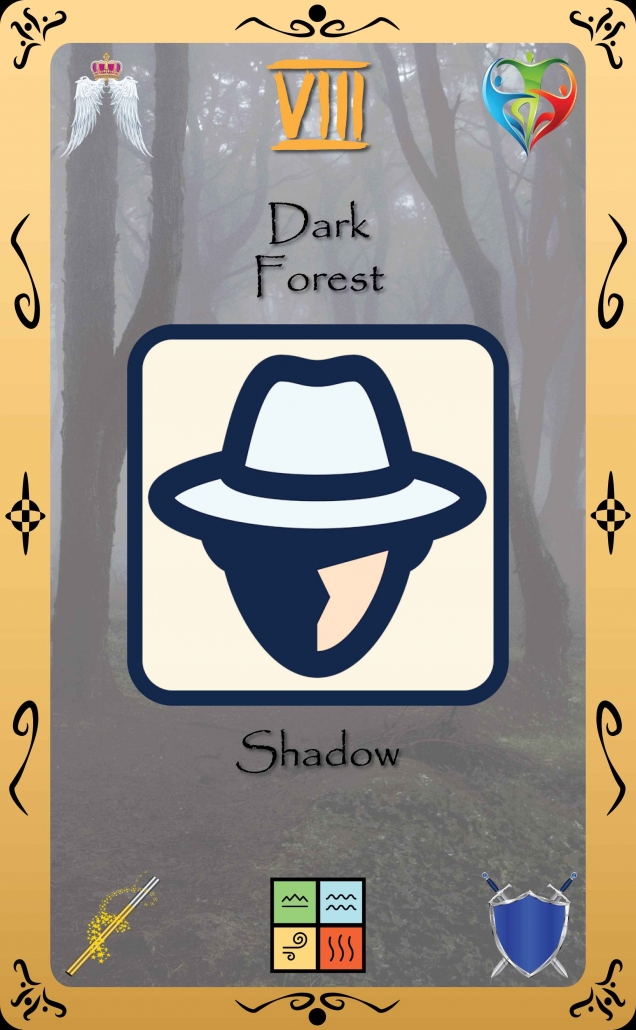
Dark Forest
Shadow
Overview
Each of us has parts or aspects of ourselves that we try to keep hidden from the rest of the world. We do this—consciously or unconsciously—because we have a negative belief about those parts: they are somehow unacceptable, inappropriate, bad or wrong. And what’s worse, because these parts exist within our overall makeup, we inadvertently come to believe that we are somehow defective or broken.
As we learn in Dark Forest, the truth is that our Shadows are actually very powerful aspects of ourselves, and if we simply take the time to meet, engage, understand and eventually embrace them, we will have a much deeper and more intimate knowing of who we really are. And this has only positive implications for the kinds of lives we are destined to live.
Situation
There is something on your horizon that you really want. It could be something that you want to obtain, or something that you want to achieve. You feel a powerful kind of hunger within you to be in a space where you actually have this, whatever it is. The problem is, you also notice that there is a part of you that is holding you back in some way. The reluctance may be manifesting as a cold, tight feeling in your gut, or it may be showing up as a voice in your head that is making your desire look very dangerous—or it may be a combination of these things.
You have an unconscious belief that to achieve or obtain the thing you want will somehow end up causing you pain, so a Shadow within you is activated by that belief and is trying to hold you back from getting hurt.
Recommendation
Congratulations! You have become aware of one of your Shadows. It is probably not immediately obvious what this part of you is attempting to create with its actions; however, most of the time, when you get down to the deepest truth of the Shadow, it almost always seeks to create one of the four core states:
- Being — characterized by words like presence, fullness, wholeness, and sovereignty.
- Serenity — characterized by words like inner peace, calmness, contentedness, and safety.
- Love — characterized by words like freedom, acceptance, honesty, and unconditional love.
- Oneness — characterized by words like inclusion, belonging, family, and relationship.
If you want to find out what your Shadow is trying to accomplish, perform the steps of a simple “shadow interview”:
- Bring your full attention to the part of you that is holding you back from getting what you want. Imagine this part as another person sitting across from you. Let this part know that you simply want to get to know him/her better and understand his/her perspective.
- Find out what this part likes to be called, so you can address him/her properly. Sometimes the response to this question will be a name (could be your nick-name as a child), or it could be a role, such as “protector” or “guard dog” or some other role. Whatever name is offered, make sure to use that name for all subsequent questions.
- Ask the part how long s/he has been around. Thank you for being here, <part’s name>. Can you tell me how long you have been present in <your own name>’s life? (Remember, you are trying to get information from the other part here, so during the interview you want to refer to yourself in the 3rd person.)
- Ask open-ended questions to get as much detail as you can from <part’s name> that help you to understand his/her motivation.
- As you uncover more and more information, you will probably learn that this part experienced some kind of pain in your early life when trying to go after what s/he wanted. As a result of this experience, s/he may have adopted a coping strategy that kept him/her safe as a child. However, this strategy is no longer working, so you as the adult now have the opportunity to provide support to the immature part of yourself that is still using this now-dysfunctional approach.
- Make sure to express deep gratitude to <part’s name> for trying to keep YOU safe, and for working so hard to bring Being, Serenity, Love, or Oneness into your life.
- Point out that, as an adult, you now have powers and capabilities that you didn’t have as a child, and that you know that the current situation is something that you can handle. Let <part’s name> know that you are choosing to go ahead and go after what you want, and that you are prepared to deal with any risks that might show up.
- Let <part’s name> know that you really appreciate the fact that s/he is looking out for your, and welcome any additional warnings that might come your way so that you can keep the dialog open.
This process is a very powerful way to bring awareness to one of your Shadow behaviors, and to convert that Shadow from a covert saboteur into an agent that can actually help you in your future endeavors.
For more information about this topic, please see the full program at Life Mastery Way (and remember the name of your card).